VIEWING ROOM
Jorge Enciso | Vigília
Curated by Tiago Sant’ana
Visual artist, curator, and PhD in Culture and Society
Vigília [Vigil]: a state of remaining awake; the act of watching over something or someone; a collective organisation around a reflection or protest. Although polysemic, in all meanings of the word, the action of remaining in vigilance is the one most frequently repeated. Vigil, as a continuous action, manifests itself in the body as an insistent attempt not to allow the exercise of attention to fail. This myriad of meanings and nuances also emerges in the set of works gathered in the first solo exhibition in Brazil by the Paraguayan artist Jorge Enciso.
Vigil, as both word and synthesising concept, is present in Enciso’s practice in both material and conceptual ways. The making of ceramics demands attentive care duringthe process of working with clay, a task that requires not only muscular strength to handle the mounds and shape the three-dimensional surfaces, but also
delicacy in handling a malleable material that must be built up inch by inch, with attention to form, detail, and finish. This entire procedure demands long-term dedication, a constant negotiation between the clay and the artist’s body, between the form sought by the act of creation and the natural, elastic dynamics of the sculpted material itself.
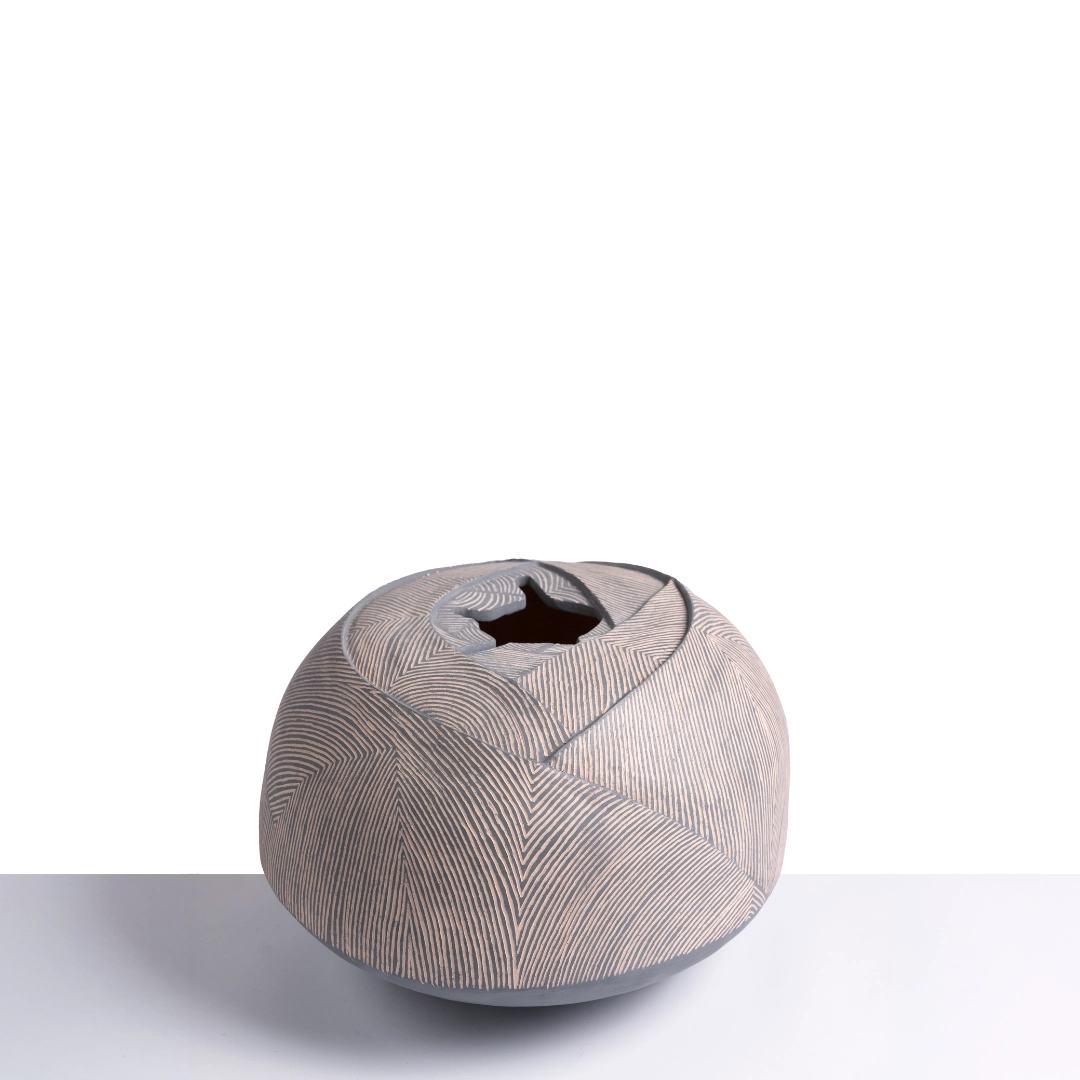
Tropiezo revelado, 2025
Jorge Enciso
White clay modelled by hand using the coil building method (stringing), covered with grey engobe, sgraffito, fired at 1,000°C.
12,2 x 17,7 x 17,3 in

Fúsion-confusión, 2025
Jorge Enciso
White clay modelled by hand using the coil building method (stringing), covered with grey engobe, sgraffito, fired at 1,000°C.
9,6 x 10 x 6,5 in
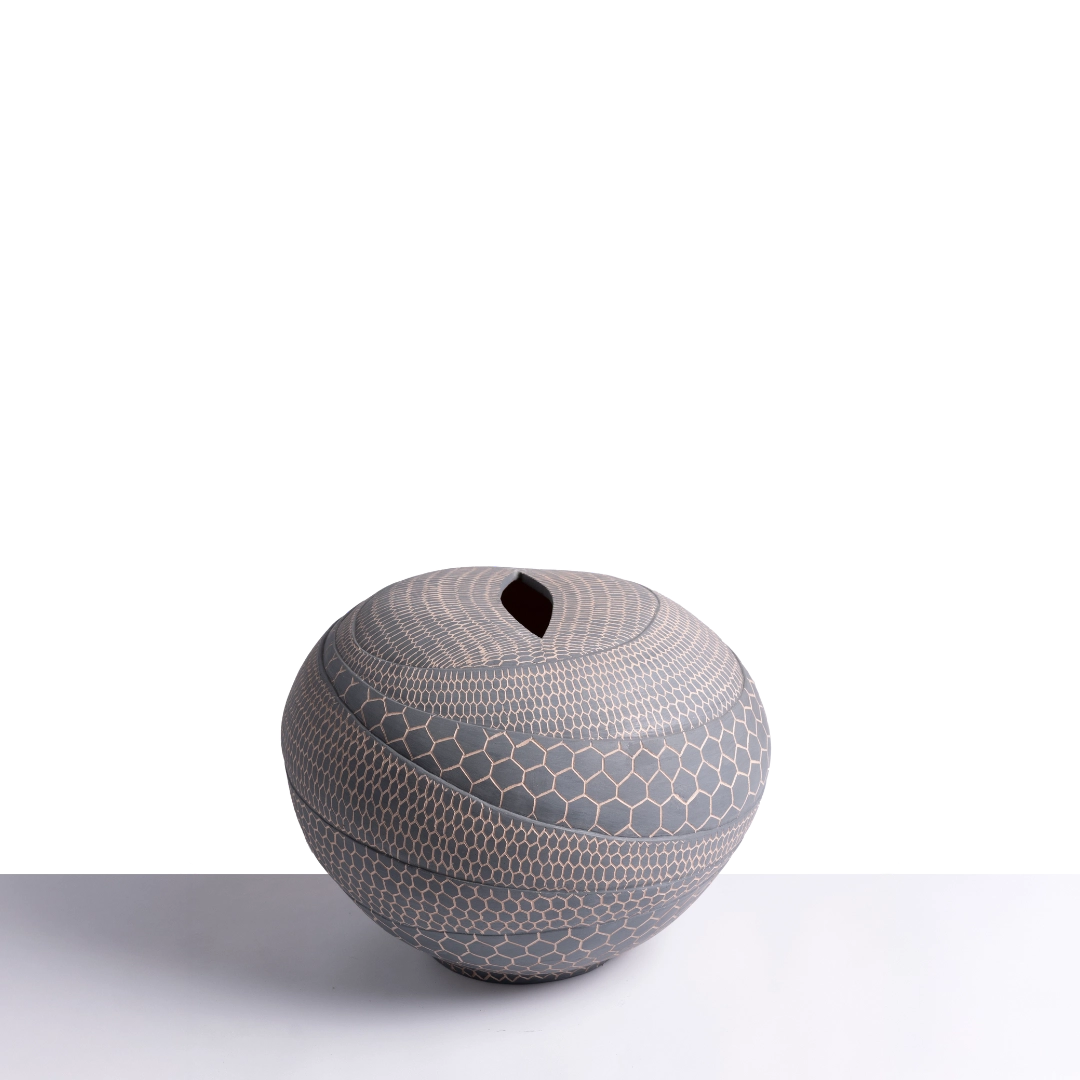
Curvas de lo invisible, 2025
Jorge Enciso
White clay modelled by hand using the coil building method (stringing), covered with grey engobe, sgraffito, fired at 1,000°C.
4,6 x 18,5 x 17,3 in
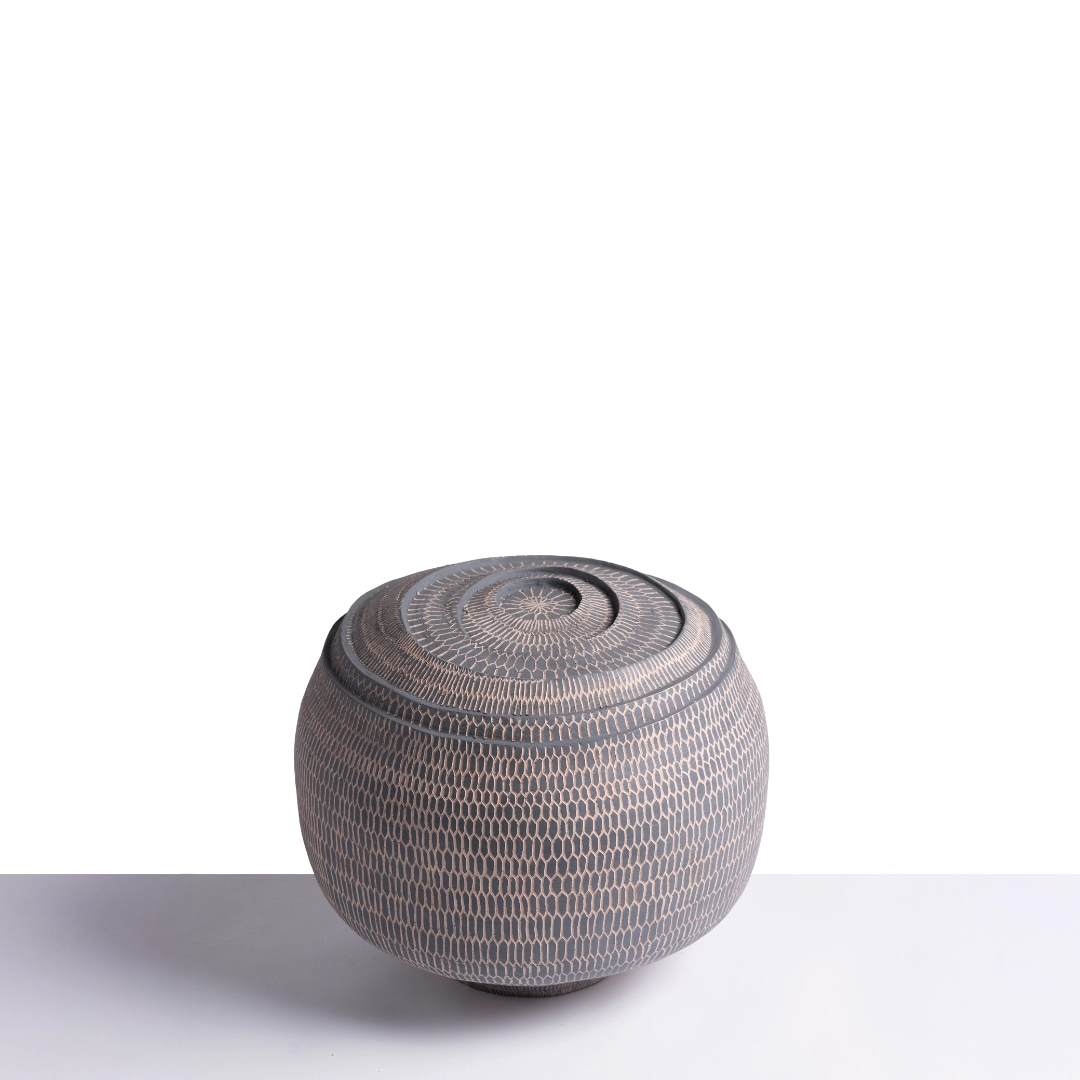
Espiral recurrente, 2025
Jorge Enciso
White clay modelled by hand using the coil building method (stringing), covered with grey engobe, sgraffito, fired at 1,000°C.
13,4 x 14,6 x 13,4 in
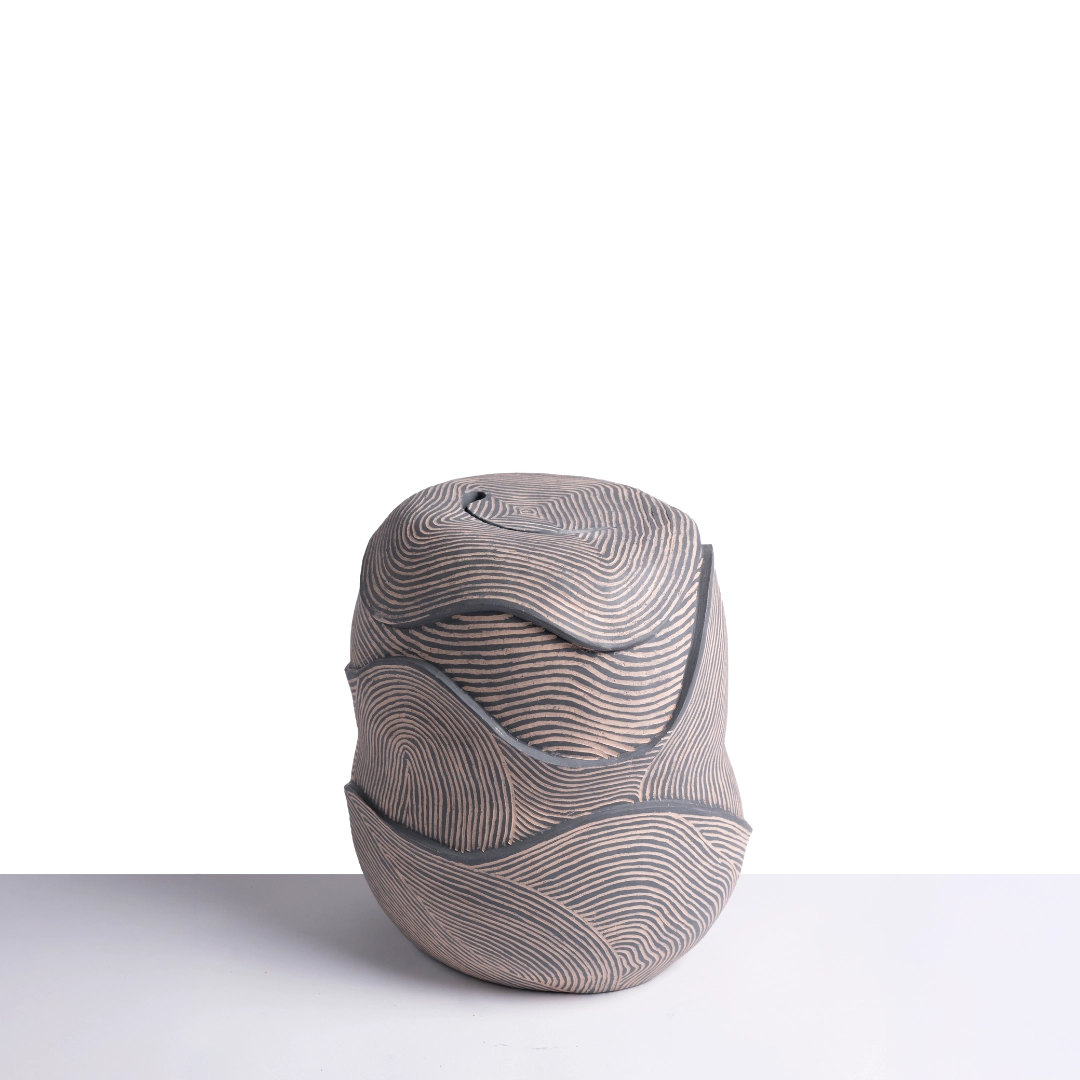
La fuga que no se nombra, 2025
Jorge Enciso
White clay modelled by hand using the coil building method (stringing), covered with grey engobe, sgraffito, fired at 1,000°C.
13,4 x 11 x 9,8 in
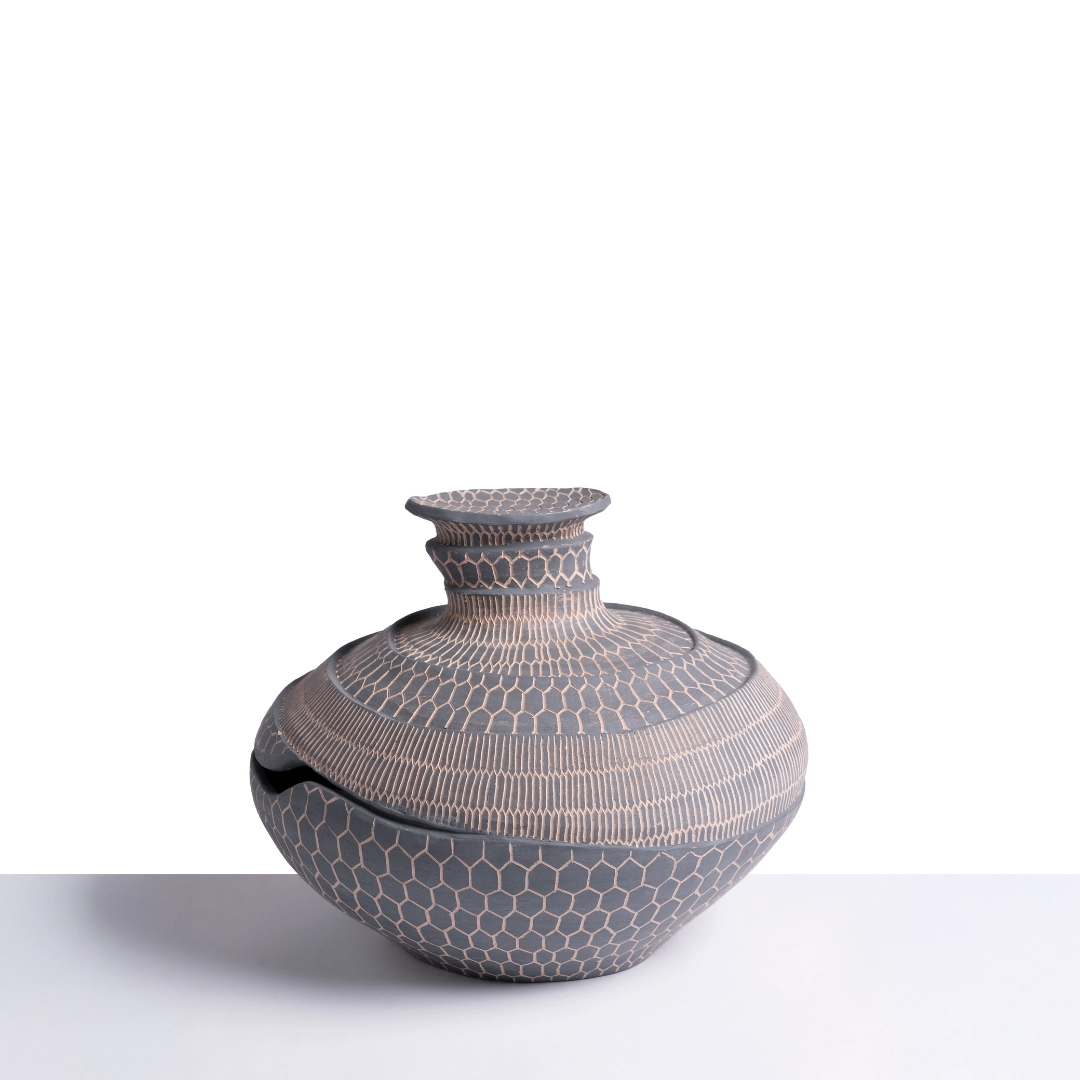
Silencio que huye, 2025
Jorge Enciso
White clay modelled by hand using the coil building method (stringing), covered with grey engobe, sgraffito, fired at 1,000°C.
13 x 15,4 x 13,4 in
The use of the sgraffito technique, a central feature of Enciso’s recent works, also demands a vigilant procedure. As he engraves forms into the bodies of the pieces, the artist meticulously weaves patterns, creates lines of tension or escape, and establishes a visual vocabulary that avoids easy confinement to his written vernacular. At times, these engravings recall honeycombs – establishing an imagistic connection with collective labour, a fundamental quality of Guaraní ceramic practice, in which everything is taught orally across generations; at others, they present lines placed side by side, which, combined with the sinuosity of the surfaces, create visual zones of convergence. Thus, within the artist’s universe, the sculpture itself is sustained as a kind of body, while writing becomes its skin, inscribed with events and marks of individuation and differentiation.
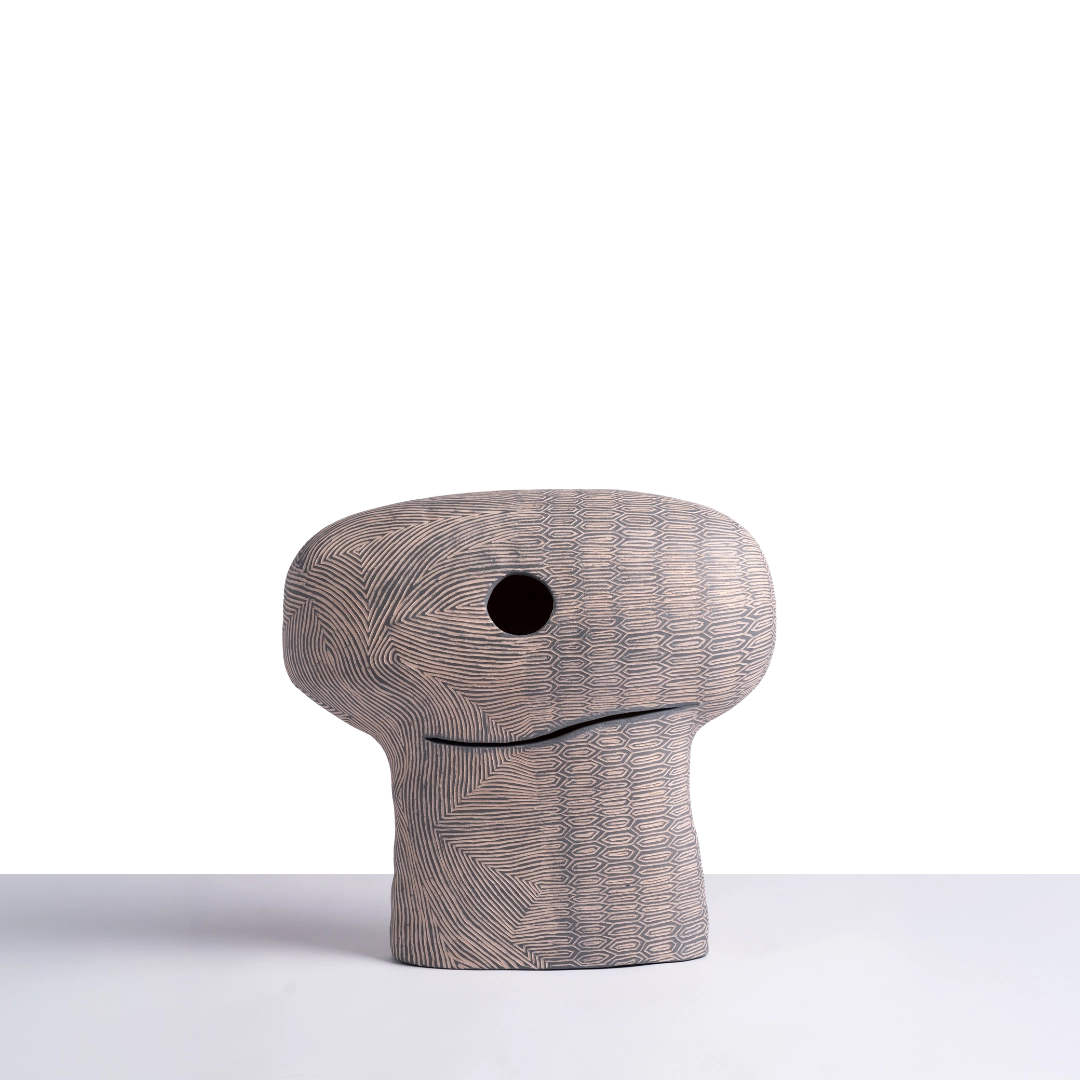
Pensamiento interrumpido, 2025
Jorge Enciso
White clay modelled by hand using the coil building method (stringing), covered with grey engobe, sgraffito, fired at 1,000°C.
17,3 x 17,7 x 7,1 in

Vertigo de la esencia, 2025
Jorge Enciso
White clay modelled by hand using the coil building method (stringing), covered with grey engobe, sgraffito, fired at 1,000°C.
22,8 x 11 x 11 in
In this sense, Enciso leads us to perceive writing and geometry against the grain of his sculptures. His proposal challenges the logical order of a merely mental, objective, and aseptic geometric practice, opening up another space which, while also strongly structured in thought, relies on gestures and revives cultural practices shaped by orality and foundational craft. By constructing line by line with fine metal rods, by bringing together gram by gram of clay with the warmth of his hands, the artist forges a kind of mestizo geometry – one that establishes aesthetic exchanges between the more hegemonic History of Art and the centuries-old practices of pre- Hispanic societies
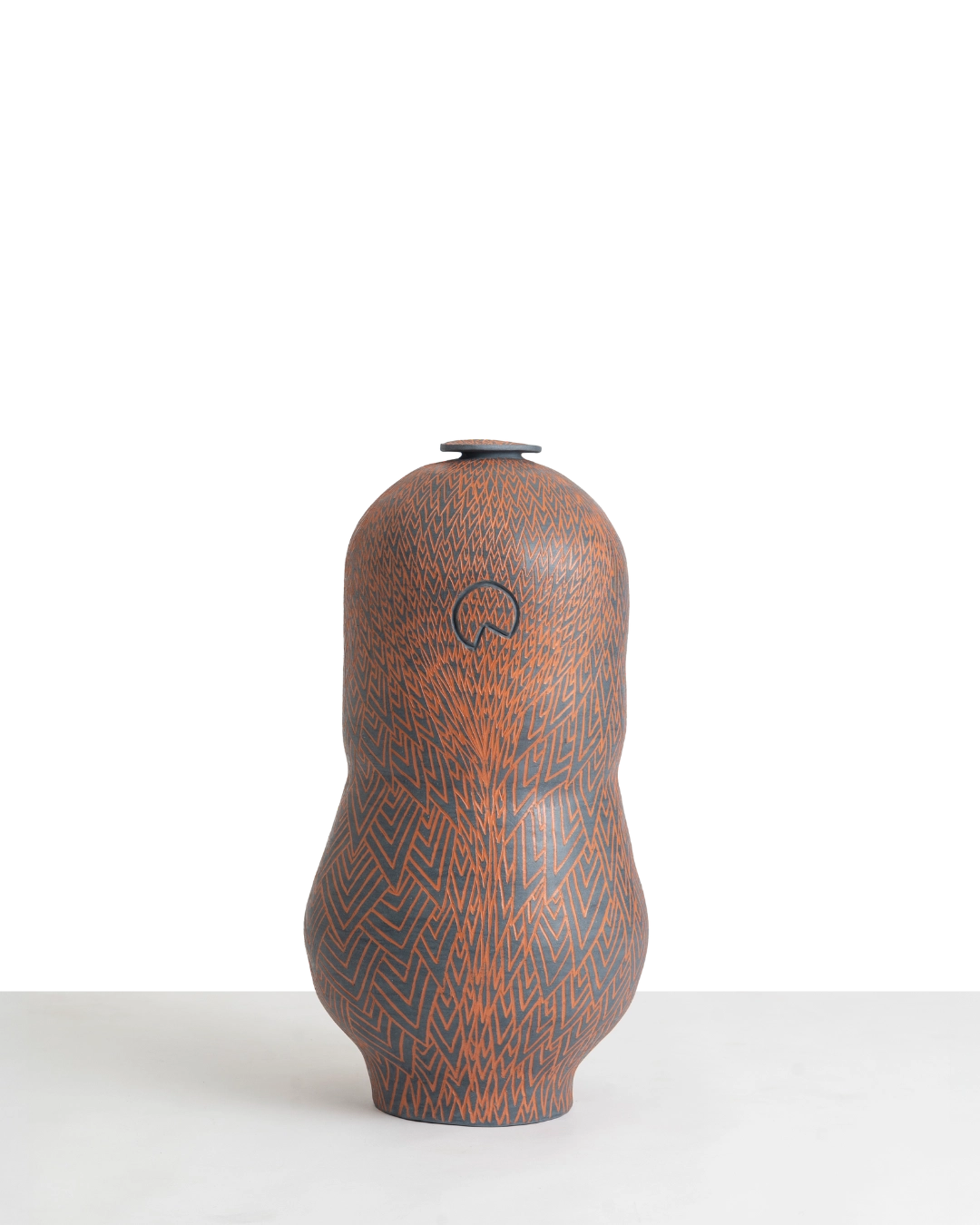
Entrelugar, 2025
Jorge Enciso
Red clay modelled by hand using the coil building method (stringing), covered with grey/blue engobe, sgraffito, fired at 1,000°C.
24,4 x 11,8 x 12,4 in
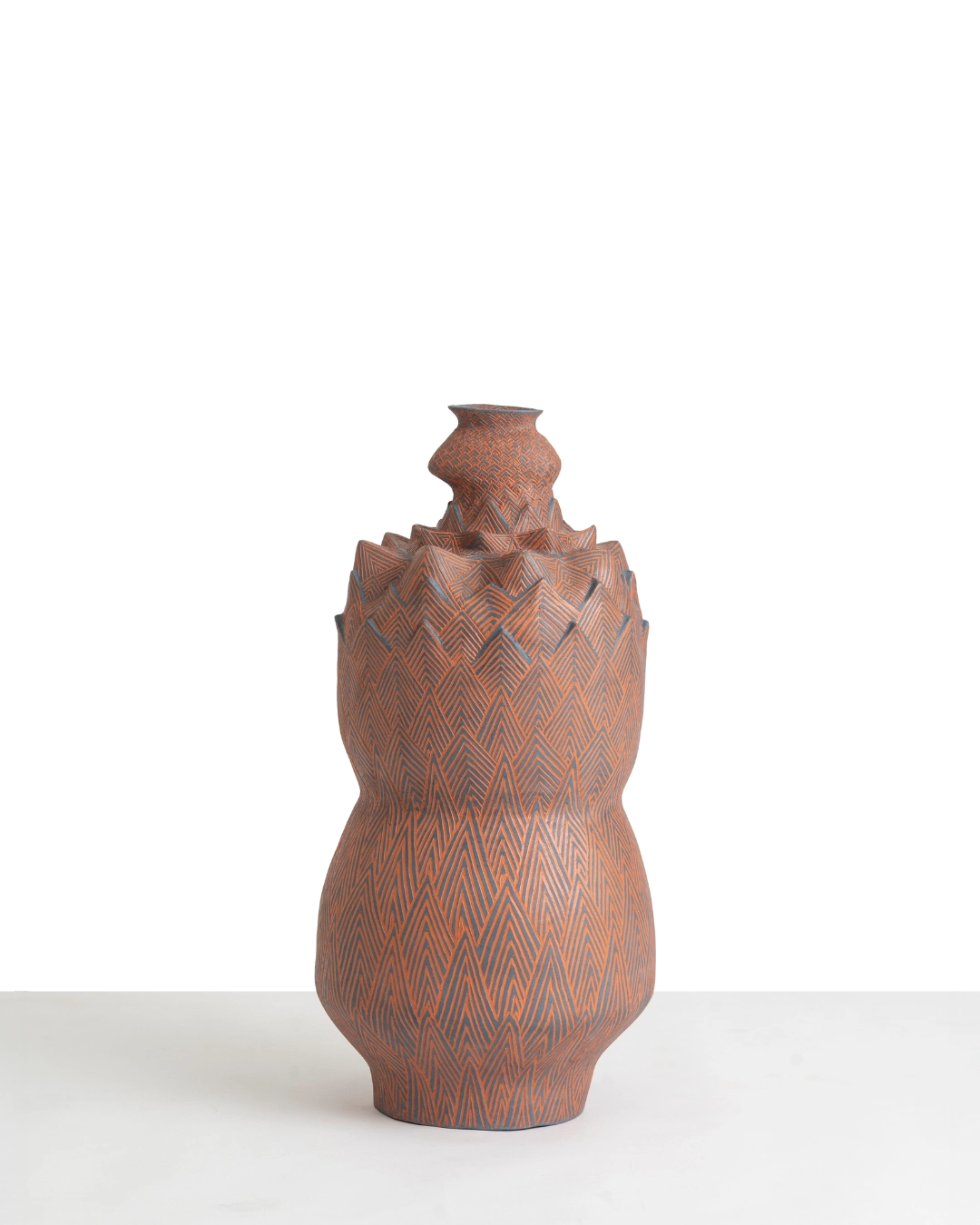
Identidad en tránsito, 2025
Jorge Enciso
Red clay modelled by hand using the coil building method (stringing), covered with grey/blue engobe, sgraffito, fired at 1,000°C.
25,2 x 11,6 x 11,6 in
In works such as Cabezas exiladas I, the artist goes further in this investigation. Enciso engraves onto the body of the sculpture written passages that narrate Guaraní cosmologies about the creation of the world, of the word, and of the bond between humanity, nature, and the divine. U nderlying this, however, is
the fact that Guaraní is not a language that follows Western patterns of writing, requiring translation into what is called “ Paraguayan Guaraní” . This passage from an oral tradition into a written record, supported by an alphabet alien to that tradition, becomes an exercise of comings and goings between conserving a culture through writing and, precisely because of this, a process of acculturation. By transposing these excerpts onto the body of the sculpture, the artist juxtaposes, on the one hand, the strength of orality present in these myths and also in the very ceramic knowledge to which he devotes himself, with, on the other, the desire for record and archive, so exalted within a more Westernised historiographical practice.

Cuerpo sin ventana, 2025
Jorge Enciso
White clay modelled by hand using the coil building method (stringing), covered with grey engobe, sgraffito, fired at 1,000°C.
27 x 11 x 11 in
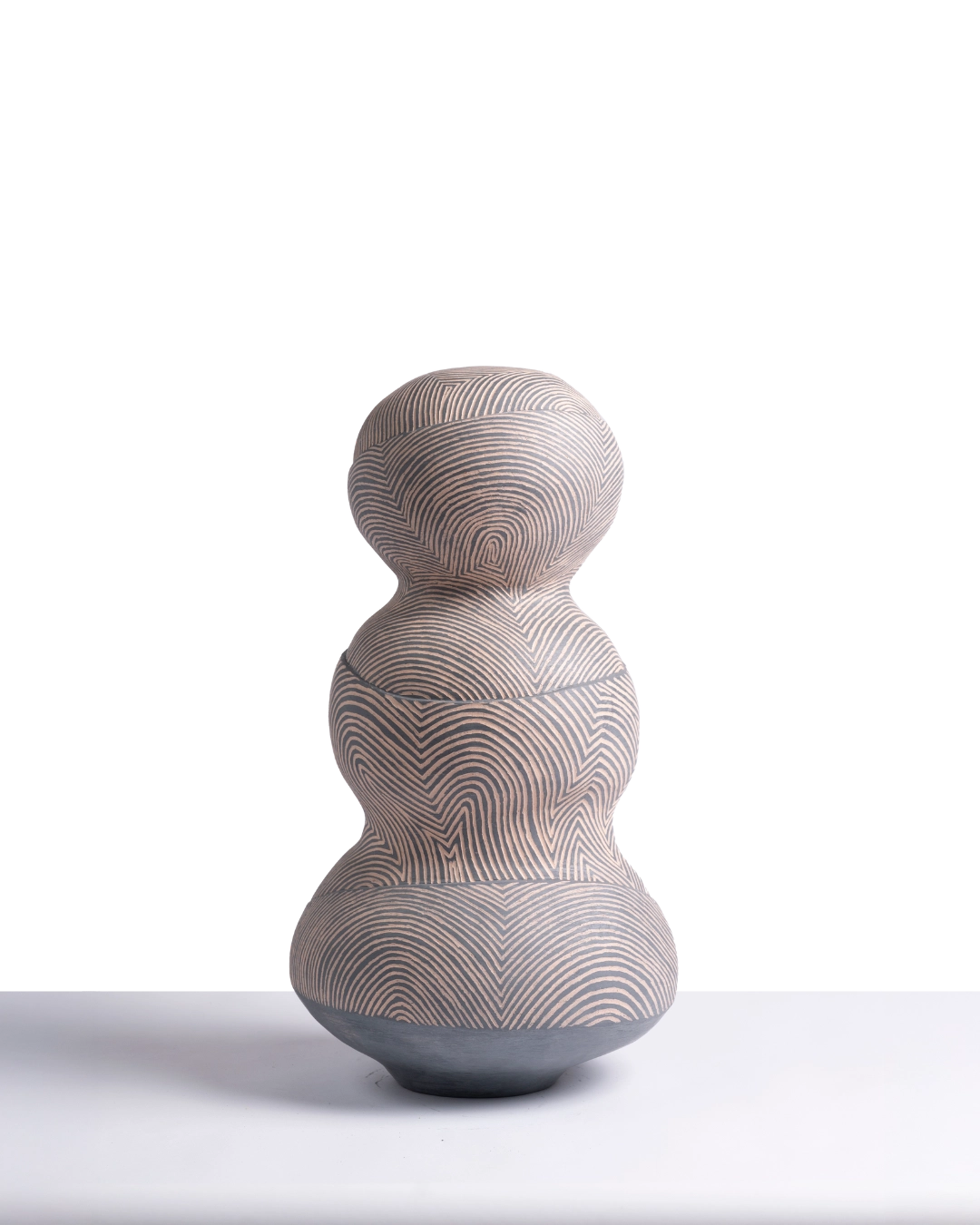
Renacimientos (II), 2025
Jorge Enciso
White clay modelled by hand using the coil building method (stringing), covered with grey engobe, sgraffito, fired at 1,000°C.
5,6 x 13,6 x 13,6 in
Through his sculptural compositions, Jorge Enciso’s Vigília is far more than the attentive hours spent handling his works. It transcends the exercise of waiting for the pieces to reach the ideal temperature in the kiln and then the exectation of their cooling. Enciso’s Vigília points towards a state of staying awake to exercise memory and, above all, for cultural processes that promote asymmetries and erasures. The artist’s sculptural practice recalls a oruba proverb which says: “While you pray, keep doing”.”

Mirada impuesta, 2025
Jorge Enciso
White clay modelled by hand using the coil building method (stringing), covered with grey engobe, sgraffito, fired at 1,000°C.
28 x 15 x 15 in

Ella mira y siente, 2025
Jorge Enciso
White clay modelled by hand using the coil building method (stringing), covered with grey engobe, sgraffito, fired at 1,000°C.
28,9 x 14,2 x 13,4 in

Vigilia, 2025
Jorge Enciso
White clay modelled by hand using the coil building method (stringing), covered with grey engobe, sgraffito, fired at 1,000°C.
25,6 x 16,1 x 13,8 in

Secreto que duerme, 2025
Jorge Enciso
White clay modelled by hand using the coil building method (stringing), covered with grey engobe, sgraffito, fired at 1,000°C.
23,6 x 12,6 x 10,2 in

Lengua de un corazon antiguo I, 2025
Jorge Enciso
White clay modelled by hand using the coil building method (stringing), covered with grey engobe, sgraffito, fired at 1,000°C.
28 x 13,8 x 6,7 in

Lengua de un corazon antiguo II, 2025
Jorge Enciso
White clay modelled by hand using the coil building method (stringing), covered with grey engobe, sgraffito, fired at 1,000°C.
28 x 13,1 x 6,3 in

Espiritu curvado, 2025
Jorge Enciso
White clay modelled by hand using the coil building method (stringing), covered with grey engobe, sgraffito, fired at 1,000°C.
26,6 x 12,6 x 11,4 in

Cabezas exiliadas III, 2025
Jorge Enciso
White clay modelled by hand using the coil building method (stringing), covered with grey engobe, sgraffito, fired at 1,000°C.
30,7 x 12,6 x 12,6 in
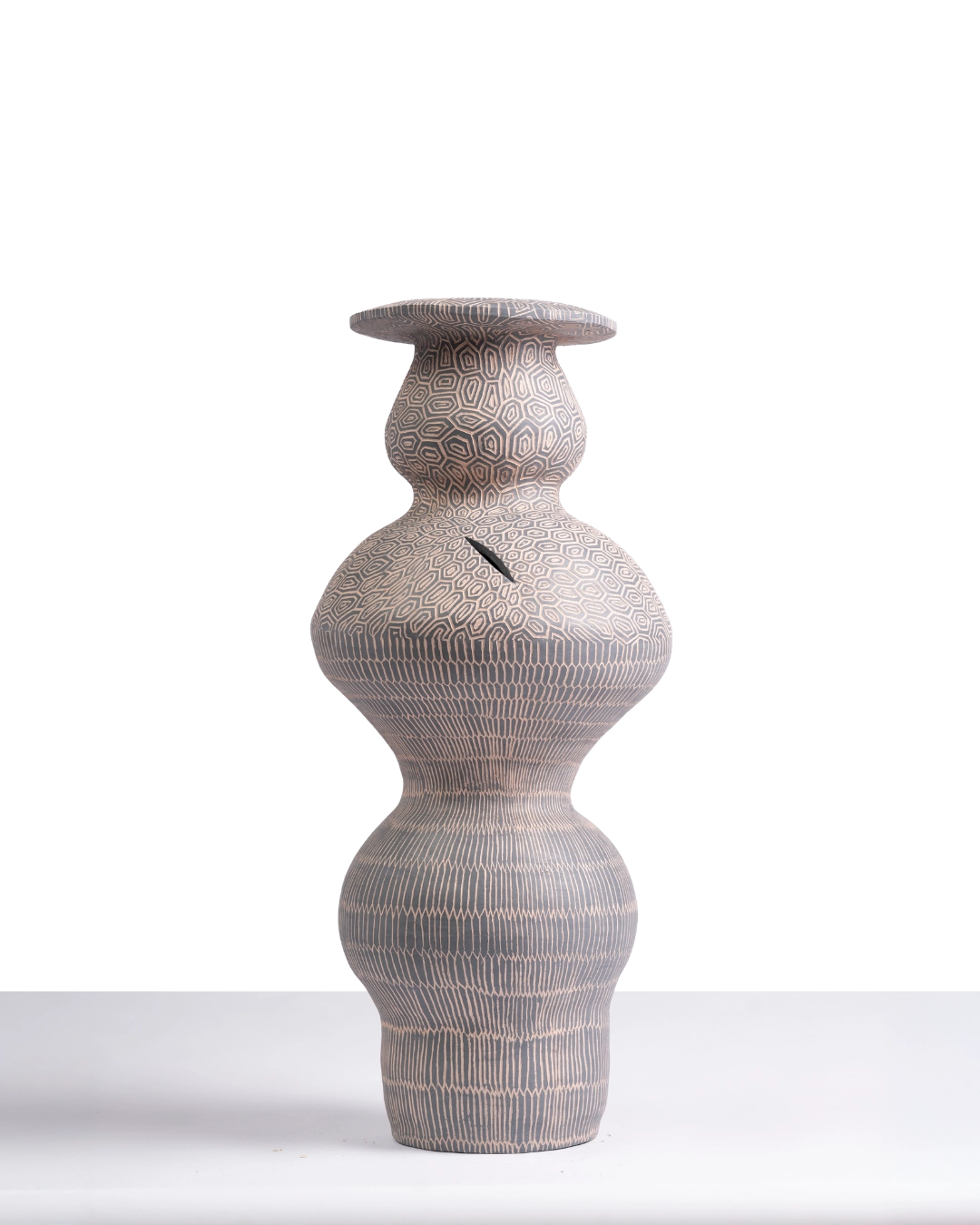
Evidencia, 2025
Jorge Enciso
White clay modelled by hand using the coil building method (stringing), covered with grey engobe, sgraffito, fired at 1,000°C.
30,5 x 13 x 13 in

Castillo donde viven los ecos, 2025
Jorge Enciso
White clay modelled by hand using the coil building method (stringing), covered with grey engobe, sgraffito, fired at 1,000°C.
29,1 x 12,6 x 12,6 in